
Heritage Intelligence: An Integrated Framework for Investigating Cultural Heritage
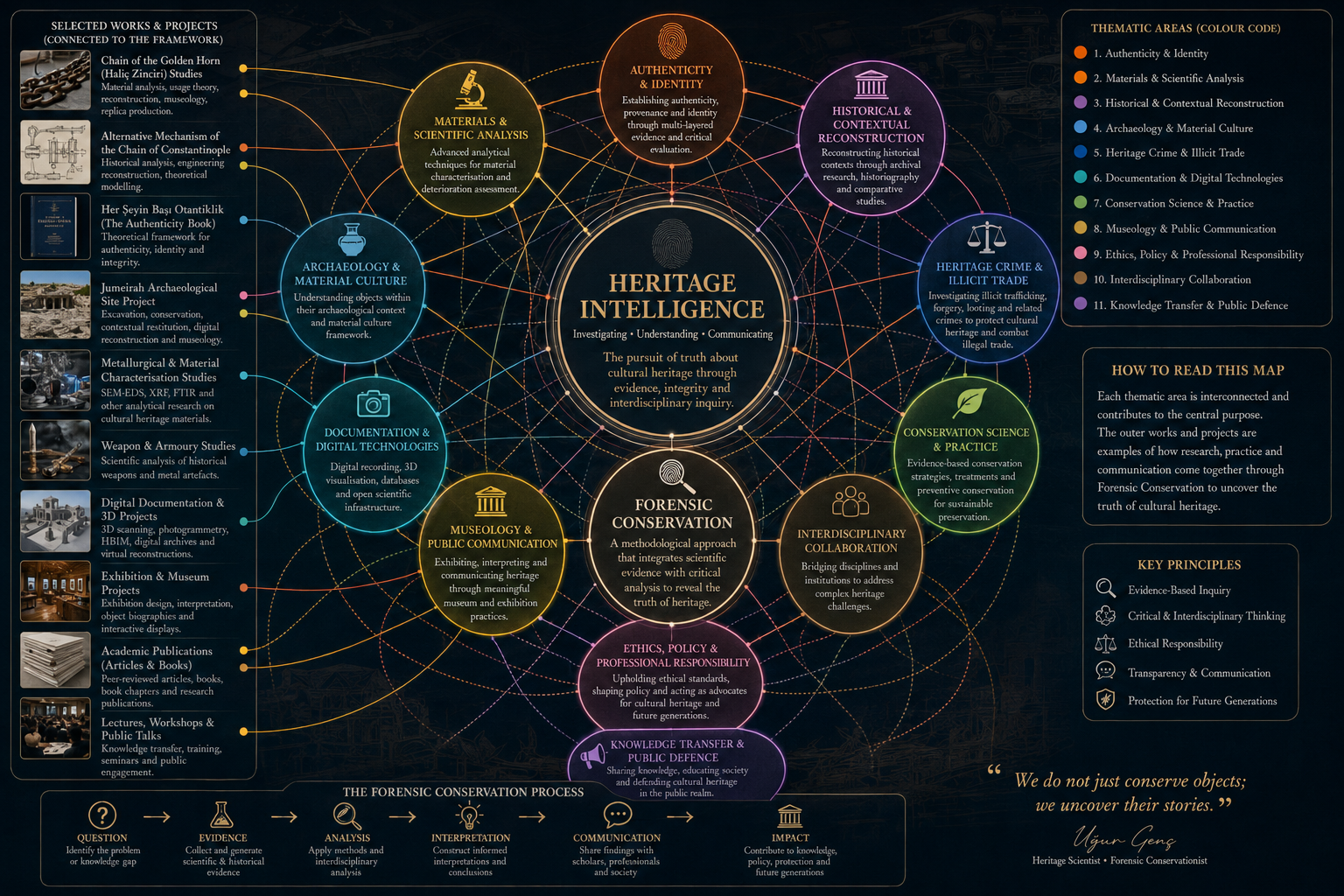
This conceptual map represents the intellectual and methodological framework that underpins my research, publications, conservation projects, and professional practice. Rather than viewing conservation, archaeometry, museology, material science, and historical research as separate disciplines, this framework proposes an integrated approach in which all these fields contribute to a single objective: revealing the truth of cultural heritage.
At the centre of this framework lies Heritage Intelligence, a concept that refers to the systematic generation of knowledge about cultural heritage through the collection, interpretation, and communication of evidence. Heritage Intelligence seeks to understand cultural objects, sites, and collections not merely as physical entities, but as complex repositories of historical, material, social, and cultural information. It is an evidence-driven process that aims to reconstruct the identity, biography, significance, and authenticity of heritage assets.
The methodological pathway that enables the production of Heritage Intelligence is what I define as Forensic Conservation. Inspired by the principles of forensic investigation, this approach employs scientific analysis, interdisciplinary inquiry, critical thinking, and contextual interpretation to investigate cultural heritage. The objective is not simply to conserve objects, but to ask the right questions, gather evidence, test hypotheses, and construct informed interpretations that contribute to a more truthful understanding of the past.
The thematic areas surrounding the centre illustrate the interconnected nature of this framework. Topics such as authenticity and identity, materials and scientific analysis, historical reconstruction, archaeology and material culture, digital documentation, conservation science, museology, ethics, and interdisciplinary collaboration are not isolated research domains. Instead, they function as interconnected components of a larger investigative system in which knowledge continuously flows between disciplines.
This interconnected structure also reflects the nature of my own academic journey. Research on the Chain of the Golden Horn, studies on authenticity and identity, archaeometric investigations, digital documentation projects, museum and exhibition practices, and publications on conservation theory are not independent endeavours. They are individual case studies and contributions that collectively support the broader mission of understanding and communicating the truth of cultural heritage.
The framework also recognises the social responsibilities of heritage research. Knowledge generated through investigation should not remain confined within laboratories or academic publications. It must be communicated responsibly to professionals, institutions, decision-makers, and the wider public. Therefore, public engagement, knowledge transfer, education, and advocacy form an integral part of Heritage Intelligence.
Ultimately, this map proposes a vision of the conservator not merely as a practitioner responsible for preserving material remains, but as an investigator, interpreter, communicator, and knowledge producer. It advocates a model of conservation in which scientific evidence, ethical responsibility, and interdisciplinary collaboration converge to uncover the stories embedded within cultural heritage.
We do not simply preserve objects; we investigate, understand, and communicate their truths.