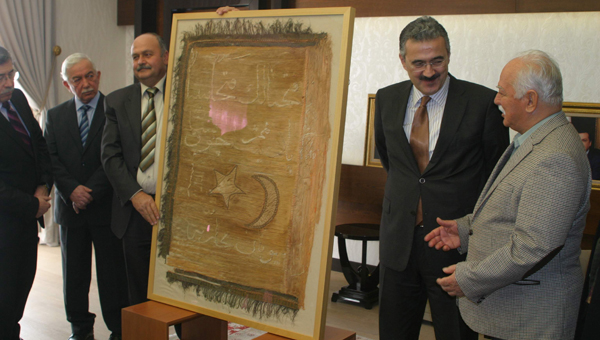
Preserving a Symbol of Valor: The 1877 Ottoman-Russian War Banner
Title: Restoration and Conservation Studies of a Historical Ottoman Flag
Author: Uğur Genç, Emine Torgan, Recep Karadağ
Context: Presented at the AUTEX 2014 – 14th World Textile Conference (Bursa, Türkiye).
The Subject: A 19th-century village banner from Aydın-Şahnalı, woven by local women for 21 soldiers during the Russo-Turkish War (War of ’93).
Abstract
Bringing together historical sentiment and modern conservation science, this project focuses on the rescue and stabilization of a rare 136-year-old Ottoman banner. As the lead conservator, Uğur Genç coordinated the intricate restoration process to stabilize the fragile cotton and silk fibers, ensuring that this sacred relic—the only returning witness of a village’s 21 martyred soldiers—could be safely exhibited in its home province.
Technical & Analytical Milestones
Scientific Characterization: To determine the correct conservation path, advanced analytical methods were employed. HPLC-DAD (High-Performance Liquid Chromatography) revealed the use of synthetic dyes consistent with the late 19th century, while SEM-EDX (Scanning Electron Microscopy) was used to analyze the metallic threads (sim), identifying a composition of copper and silver.
Textile Conservation: The banner arrived in a critical state, suffering from significant fragmentation and glass deposits from a previous damaged frame. The restoration involved meticulous mechanical cleaning, desalination, and the precise realignment of separated threads.
Support & Stabilization: A specialized support fabric, dyed with natural colorants to match the original hue, was prepared. Utilizing modern conservation adhesives (Paraloid B-48S) and needlework, the banner was secured onto its new backing without compromising its historical integrity.
Preventive Display Strategy: Post-restoration, the banner was housed in a custom-engineered frame using UV-filtered glass and tropical obeche (Triplochiton scleroxylon) wood to ensure long-term protection against biological and environmental deterioration.
Significance
Beyond its technical challenges, the restoration of the Şahnalı Banner is an act of “Emotional Restoration.” By stabilizing the physical fabric, the project restores the tangible connection to the legendary sacrifice of the Şahnalı village. It stands as a prime example of how the conservator acts as a bridge between scientific data and national memory.
Genç, U., Torgan, E. and Karadağ, R. (2014). “Restoration and Conservation Studies of a Historical Ottoman Flag” [Poster], 15th AUTEX World Textile Conference, 26-28 May, Bursa.
