Redefining the Conservator: From Silent Technicians to Strategic Storytellers
Journal: Journal of Humanities and Tourism Research (2026, Vol. 16, Issue 2, pp. 217-235)
Document Type: Peer-Reviewed Research Article
Core Pillars: Preventive Conservation, Participatory Museology, Experience Economy, Heritage Literacy
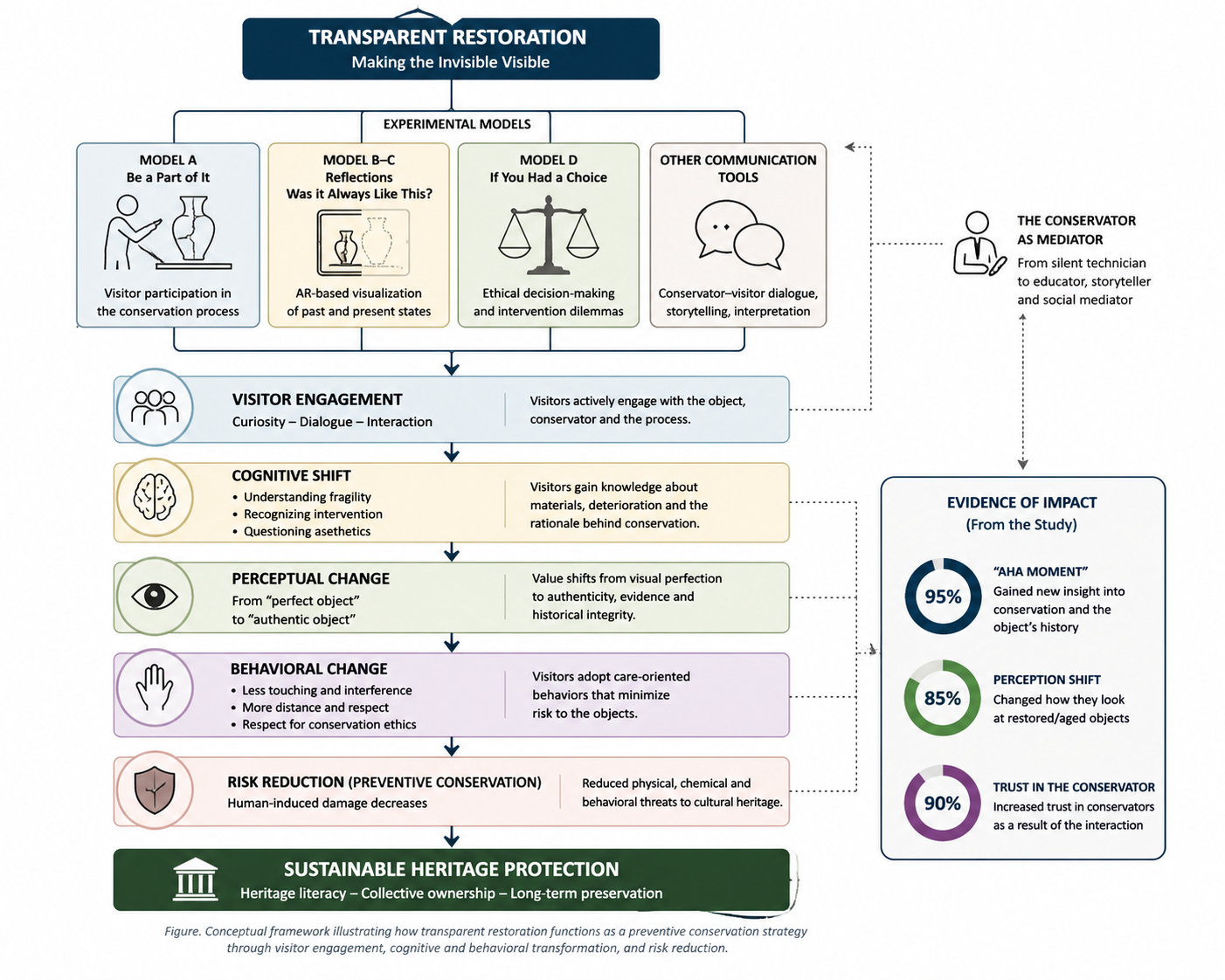
For decades, the traditional conservation-restoration workflow operated as an epistemic ‘black box’—a strictly micro-level, laboratory-bound technical service hidden entirely from the public gaze. This peer-reviewed study, published in the Journal of Humanities and Tourism Research (2026), challenges this institutional orthodoxy by framing Transparent Restoration not merely as a communication exercise, but as a robust, proactive Preventive Conservation Strategy for global heritage sustainability.
By opening the laboratory doors and making the ‘in-process’ state of an artifact visible, we bridge the gap between elite expert knowledge and public perception. The research systematically evaluates four operational models I have developed and deployed—‘Be a Part of It’ (Symbolic Agency), ‘Reflections’ (Real-time AR Integration), ‘Was it Always Like This?’ (Chronological Decay Mapping), and the choice-driven ethical framework ‘If You Had a Choice’. Empirical data reveals that staging the ethical dilemmas and material biographies of cultural property triggers a permanent cognitive shift in visitors, transforming passive consumers into active, literate guardians of collective memory.”
Key Highlights & Empirical Insights
The Shift from Micro to Macro: Elevating structural material science (micro) into a macroeconomic tool for sustainable tourism, experience economy, and public cultural policy.
95% “Aha Moment” Vector: Quantitative analysis confirms that visual and tactical interaction fundamentally shifts the public’s perception of authenticity away from cosmetic perfection toward historical truth.
Weapon Against Disneyfication: Grounded firmly in Cesare Brandi’s classical doctrine, the models use direct transparency (such as the proposed ‘Ethical Barcode’ and ‘UV Light Testing’) to immunize cultural institutions against superficial commercialization.
Operational Inventions: Introducing the concept of the ‘Strategic Conservation Communicator’ to seamlessly balance high-impact public mediation sessions with active laboratory workloads.
The public awareness and visibility models presented in this article were officially evaluated by the London-based IIC Committee and selected for the Finalist Shortlist of the prestigious 2026 Keck Award for their visionary philosophy.