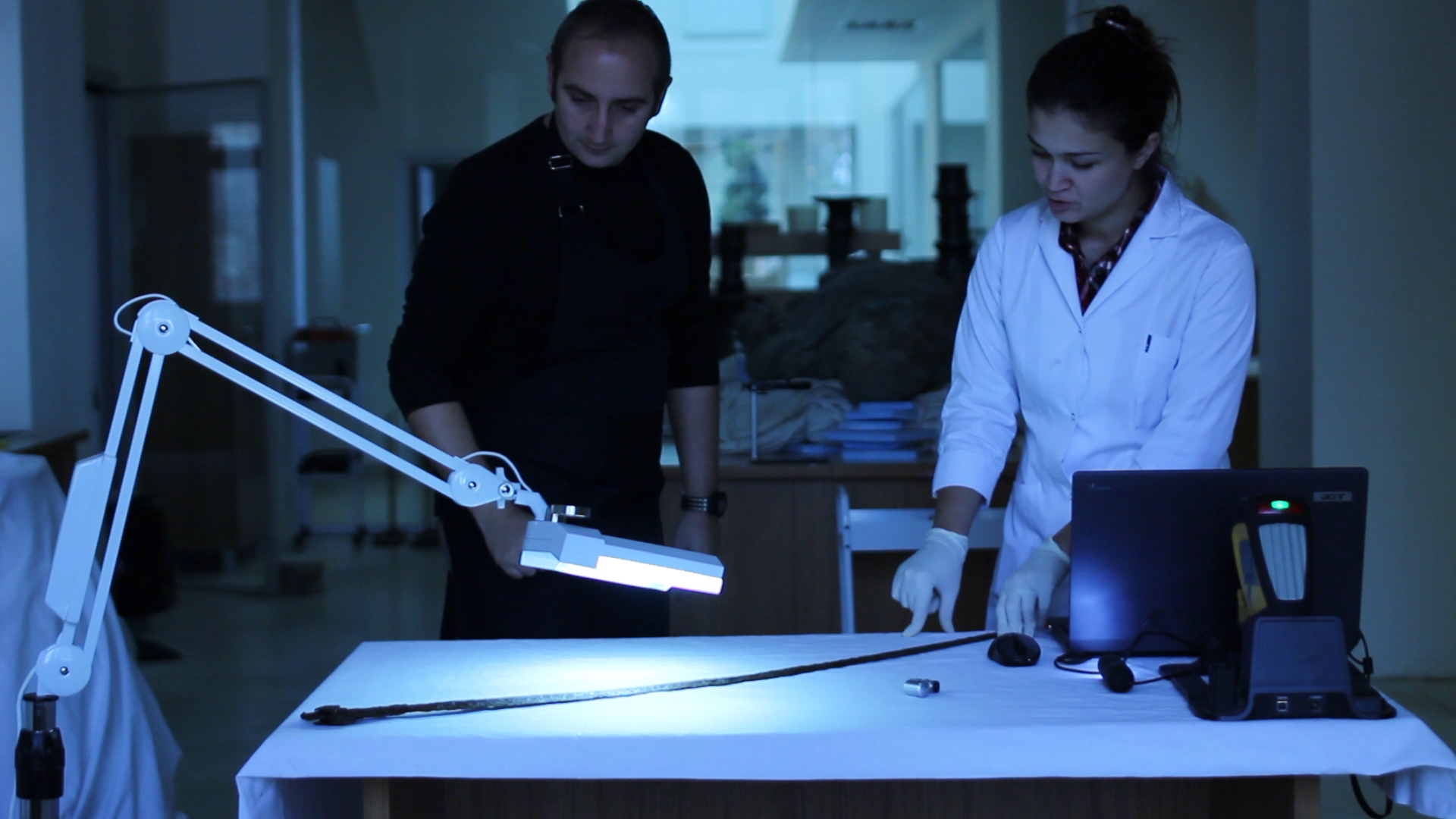
The Forensic Verdict: Resolving the Global “Seljuk Sword” Mystery through Material Intelligence
Title: The Seljuk Swords Research Project (Selçuklu Kılıçları Araştırma Projesi)
Author: Uğur GENÇ (Conservator-Restorer / Principal Investigator)
Publication: XX. International Symposium on Medieval and Turkish Era Excavations and Art History Research, (November 2-5, 2016, Sakarya), pp. 433-452.
Year: 2016
Defining Authenticity in the Absence of Context
When a series of ‘unprecedented’ swords emerged from the antique markets of Istanbul, attributed to the Seljuk era but lacking any scientific excavation context, they presented a profound challenge to both art history and conservation science. As the Principal Investigator, I launched the Seljuk Swords Research Project to resolve this ‘Institutional Forensic Blindness.’
This final paper documents the high-level forensic interrogation of 11 individual swords. By integrating Digital Radiography to examine internal joinery, SEM-EDX to verify natural vs. artificial oxidation, and Carbon-14 dating (via Oxford University), we moved beyond visual persuasion. The investigation revealed a critical truth: while the materials themselves are historical witnesses from various Turkic nomadic cultures (Avar, Khazar, Cuman), the symbolic ‘Seljuk’ engravings were later additions. This study stands as a definitive methodology for how Forensic Conservation can protect the authentic narrative of history from anachronistic interpretations.
Key Highlights & Impact
Methodological Sovereignty: Establishing a non-destructive protocol for the authenticity verification of unprovenanced metallic heritage.
The “Double-Headed Eagle” Anomaly: Proving that certain symbolic engravings were modern interventions applied to genuine historical blades.
Global Comparative Analysis: Re-identifying the swords as part of a broader Asian-Turkic military heritage (Avar, Pecheneg, Golden Horde) by cross-referencing data with the Metropolitan Museum and Varna Archaeology Museum.
Scientific De-bunking: Correcting long-standing museum misidentifications (including the ‘Nimcha’ sword in national collections) using metallurgical evidence.
Epistemic Legacy: Demonstrating that ‘waiting and interrogating’ is the only ethical path to prevent conservation from becoming a tool for creating ‘false history.’
Genç, U. (2017). “The Seljuk Swords Research Project” (Selçuklu Kılıçları Araştırma Projesi). Proceedings of the XX. International Symposium on Medieval and Turkish Era Excavations and Art History Research, (November 2-5, 2016, Sakarya University), Sakarya University Publications, Vol. 2, pp. 921-940.