Forensic Conservation of the Tepeköy Mass Grave Finds
Title: Laboratory Investigations of the Erzurum-Tepeköy Mass Grave Excavation and Finds
This research presents a pioneering application of Forensic Conservation, where archaeological artifacts were treated as forensic witnesses to decode the tragic events of 1918 in Tepeköy, Erzurum. Initially brought to the laboratory for standard conservation, these finds—ranging from personal belongings to military ballistics—were subjected to advanced scientific analyses to verify historical narratives and eyewitness accounts.
A “Silent Witness” – The Severed Hand: One of the most poignant moments of the study involved a leather glove containing skeletal remains. Through Computed Tomography (CT) scans—a collaboration with Dr. Mehmet Görgülü—it was determined that the hand belonged to a 25-30-year-old male and had been severed from the body by a sharp tool or an explosion. This collaboration laid the foundation for long-standing scientific cooperation with Dr. Görgülü.
Ballistic Evidence: Conservation and microscopic cleaning of bullet casings revealed a unique “917” production stamp and the Armenian letter “Mem” (Մ). This evidence confirms the use of non-local, specialized ammunition, providing critical data for the political and military context of the period.
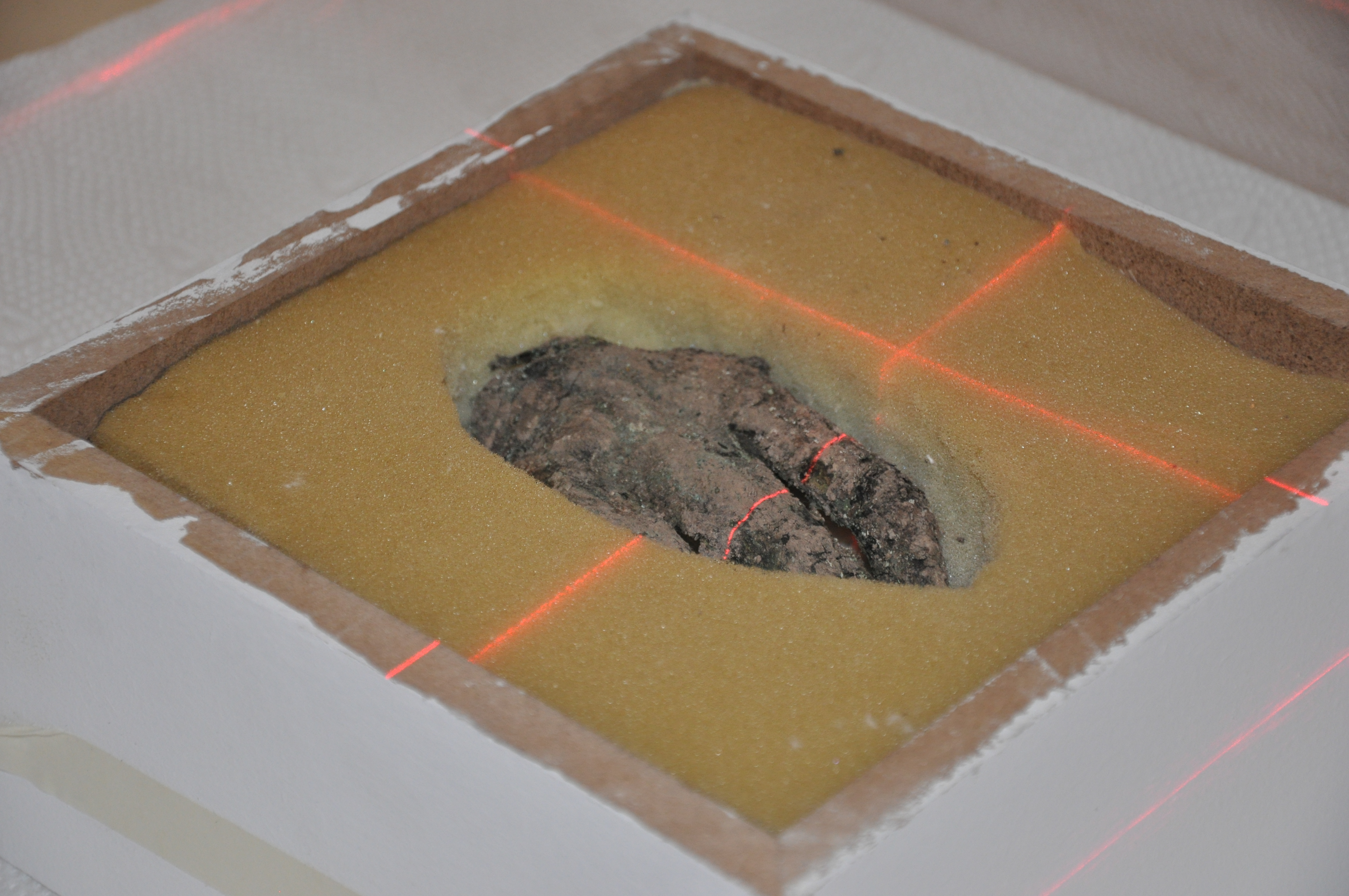
Radiographic Discovery: A metal object, initially identified as a powder flask, was examined using X-ray Radiography at the TAEK NDT Laboratory. The scans revealed a complex internal spring and fuse mechanism, suggesting the object was likely a specialized hand grenade used during the massacre.
Interdisciplinary Collaboration: Under the leadership of Museum Director Mustafa Erkmen, the project successfully integrated archaeological excavation data with advanced laboratory analysis, resulting in new historical knowledge regarding the victims’ identities and the methods of the tragedy.
By combining Archaeometry, Radiography, and Medical Imaging, this study demonstrates how a conservator can move beyond “repairing objects” to “reconstructing history.” The finds, now preserved and exhibited at the Erzurum Archaeology Museum, serve as permanent scientific evidence of the events of 1918.
Genç, U., Erkmen, M. (2014). “Erzurum-Tepeköy Kazısı ve Buluntularının Laboratuvar İncelemeleri”, 1. Uluslararası Türk-Ermeni İlişkileri ve Büyük Güçler Sempozyumu, (2-4 Mayıs 2012, Atatürk Üniversitesi, Erzurum), Atatürk Üniversitesi Yayınları, 1011-1034.
